
八、蒋彝:在苏格兰掀起“中国风”的中国画家
Chiang Yee: The Chinese Painter Who Inspired the "Chinese Wave" in Scotland
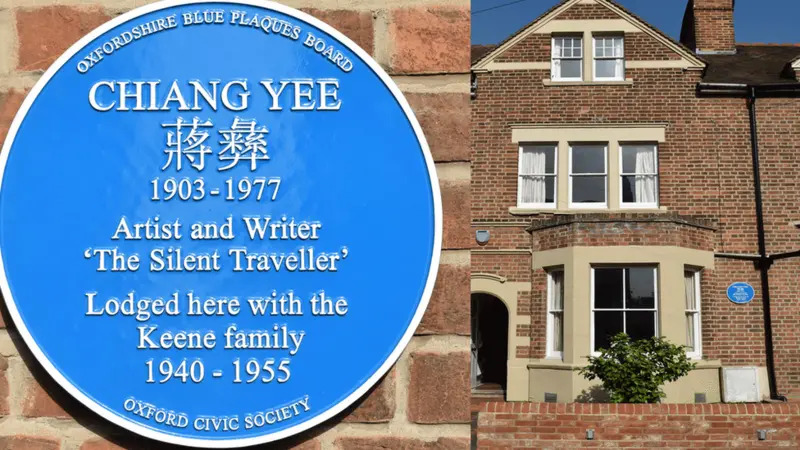
图:蒋彝故居及蓝牌标识
Image: Chiang Yee's former residence and blue plaque.
在英国牛津一座寻常的爱德华时期公寓楼前,挂着一块由政府文化保护部门特批的名人故居蓝牌。“蒋彝”两个正体汉字吸引了不少路人的目光。
In front of an ordinary Edwardian apartment building in Oxford, hangs a blue plaque, a historical marker specially approved by the British government's cultural heritage department. The two traditional Chinese characters for 'Chiang Yee' (蒋彝) catch the eyes of many passersby.
英国全境900多块名人故居蓝牌中,属于中国人的只有三块:一块是英格兰北部的孙中山故居,一块是伦敦西城的老舍故居,而这第三块,正是2019年专门为“哑行者”蒋彝设立的。
Out of more than 900 blue plaques across the UK, only three belong to Chinese individuals: one for Sun Yat-sen in northern England, another for Lao She in West London, and this third one, dedicated specifically in 2019 to Chiang Yee, The Silent Traveller.
这位与中国民主革命的伟大先行者孙中山先生、人民艺术家老舍先生并列的华人,究竟有怎样传奇的一生?
Who exactly was this remarkable individual, ranked alongside Dr. Sun Yat-sen, the great pioneer of China’s democratic revolution, and Lao She, the beloved people's artist?
(一)愤世出国 “管宁浮海非逃世”
Went Abroad Disillusioned with the Political Chaos

1903年,蒋彝出生于江西九江。因父亲是当地颇有声望的国画家,他自幼便在诗词、书画和古籍的浸润中长大。青年时代,他积极投身反帝爱国活动,抱着“科学救国”的理想在南京国立东南大学修读化学,后投身北伐,并先后任九江、芜湖和当涂县县长。
Chiang Yee was born in Jiujiang, Jiangxi, in 1903. As his father was a local painter of high repute in the traditional Chinese style, Chiang grew up immersed in classical poetry, calligraphy, painting, and ancient texts. In his youth, he actively threw himself into anti-imperialist and patriotic movements. Guided by the ideal of saving the nation through science, he studied chemistry at National Southeastern University in Nanjing. Later, he joined the Northern Expedition and went on to serve as magistrate for three different counties across Jiangxi and Anhui, including his hometown of Jiujiang.
时局的混乱腐败,让这位正直的中国青年极度失望。30岁时,他决定远赴英伦开拓视野。临行前,他吟诗自勉:“管宁浮海非逃世”。1933年抵英后,凭借扎实的国学功底,他通过了伦敦大学东方学院中文系教授、曾任末代皇帝溥仪英文教师的庄士敦爵士的面试,获得了一份教授中文的工作。
Deeply disillusioned by the political chaos and corruption of the era, the upright young Chinese man made a decision at the age of thirty to travel to Britain. His goal was to broaden his horizons. Before his departure, he composed a poem to inspire himself, writing, 'Like Guan Ning crossing the sea, I am not fleeing the world.' After arriving in Britain, relying on his solid foundation in classical Chinese studies, he passed an interview with Sir Reginald Johnston, a professor in the Department of Chinese at the School of Oriental Studies, University of London, who had famously served as the English tutor to Puyi, the Last Emperor. With this, Chiang secured a position teaching Chinese.
(二)烽火牛津 “哑行者”的异国朋友圈
The Birth of Silent Traveller Travelogue Series
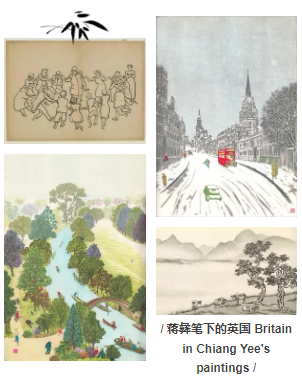
来到英国后,蒋彝被乡村景色吸引,希望出版一本“用中国传统水墨山水画技法与诗文”,来描绘英伦山水风景的画册。当时的英国出版商认为西方读者绝不可能接受,经多方磋商,才以不付稿费、仅赠送作者六本书的苛刻条件勉强印行。然而,书于1937年一问世便在西方读者中引发了巨大的轰动,迅速成为畅销书,这也开启了蒋彝极具影响力的“哑行者”游记系列。
After arriving in Britain, Chiang Yee was captivated by its countryside scenery. He hoped to publish an illustrated book that would depict the British landscape using traditional Chinese ink wash painting techniques and classical poetry. At the time, British publishers believed that Western readers would never accept such a concept. Only after extensive negotiations did a publisher reluctantly agree to print it, under the harsh conditions of paying zero royalties and giving the author just six complimentary copies. However, upon its release in 1937, the book caused an immediate sensation among Western readers and quickly became a bestseller. This marked the beginning of Chiang Yee's highly influential Silent Traveller travelogue series.
二战爆发后,蒋彝在伦敦北区的住所被炸毁。无家可归的他来到了大学城牛津,被当地一户叫吉恩的家庭收留,一住就是15年。他与当时在英的中国文学英译巨匠杨宪益、战地记者萧乾、诗人王礼锡和陆晶清等人,在伦敦和牛津织起了一个重要的战时华人社交网络。他们紧密合作,积极奔走,帮助英国民众了解中国人民反抗日本侵略的真实遭遇。
Following the outbreak of World War II, Chiang Yee's residence in North London was destroyed in a bombing. Left homeless, he arrived in the university city of Oxford, where he was taken in by a local family named Jeane. He would end up living with them for fifteen years. He wove an important wartime network of Chinese intellectuals in Britain, collaborating closely with Yang Xianyi (a titan of Chinese literary translation), Xiao Qian (a famous war correspondent), and the poets Wang Lixi and Lu Jingqing. Working hand in hand, they campaigned tirelessly to help the British public understand the true plight of the Chinese people resisting Japanese invasion.
(三)结缘苏格兰 当中国水墨遇见罗伯特·彭斯
A Connection with Scotland
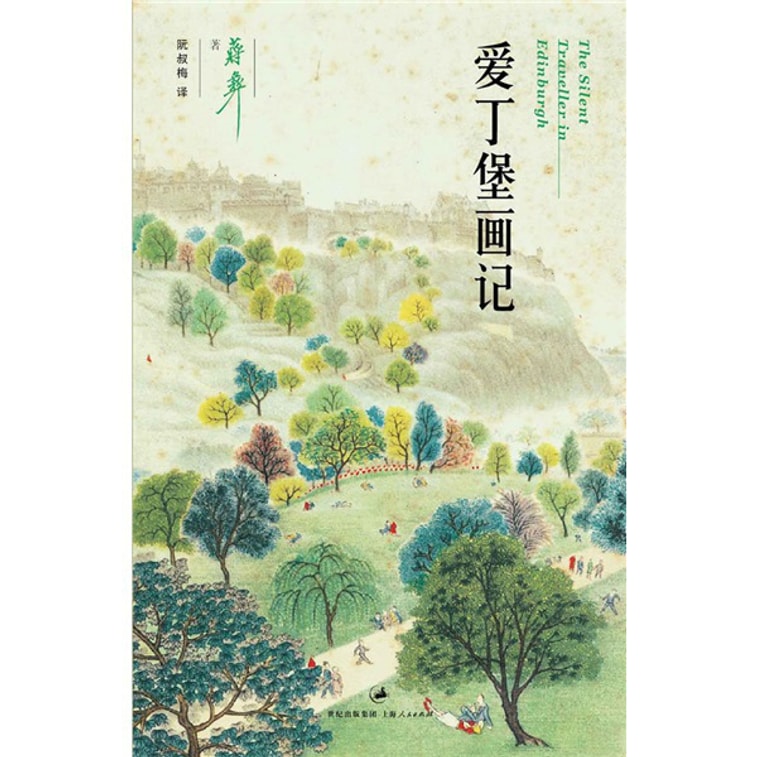
图:蒋彝所著《爱丁堡画记》
Image: The Silent Traveller in Edinburgh by Chiang Yee.
在蒋彝漫游英伦的岁月中,苏格兰是他极具代表性的一笔。在《爱丁堡画记》中,他专门用大量篇幅描绘了苏格兰高地的壮丽风光、爱丁堡的古朴街巷和苏格兰人的日常生活。
Among the years Chiang Yee spent roaming Britain, Scotland marked a highly representative chapter of his journey. In The Silent Traveller in Edinburgh, he devoted considerable space to portraying the magnificent scenery of the Scottish Highlands, the ancient streets and alleys of Edinburgh, and the daily life of the Scottish people.
蒋彝还写到苏格兰著名诗人罗伯特·彭斯,深感彭斯诗歌中对普通人的关爱,与中国儒家文化高度共通。为了这奇妙的缘分,他不仅将中国2500年前的《诗经》篇章翻译成英文,与彭斯的歌谣隔空唱和,指出彭斯的思想几乎完全可以节录自《论语》中的“仁者,人也”,甚至还亲手画了一幅身穿中国长袍、手持折扇、踱着方步的苏格兰诗人彭斯素描像。
Chiang Yee specially wrote about the celebrated Scottish poet Robert Burns. Deeply moved by the profound compassion for ordinary people in Robert Burns's poetry, he found it highly resonant with Chinese Confucian culture. To celebrate this wondrous affinity, Chiang Yee did more than just translate chapters from the Book of Songs, which was written in China 2,500 years ago, into English to create a cross-temporal dialogue with Robert Burns’s ballads. He also pointed out that Burns’s philosophy could almost be excerpted from the Confucian concept of 'Benevolence is humanity' in the Analects. He went so far as to personally sketch a portrait of the Scottish poet, depicting Robert Burns strolling in a traditional Chinese long robe, holding a folding fan.
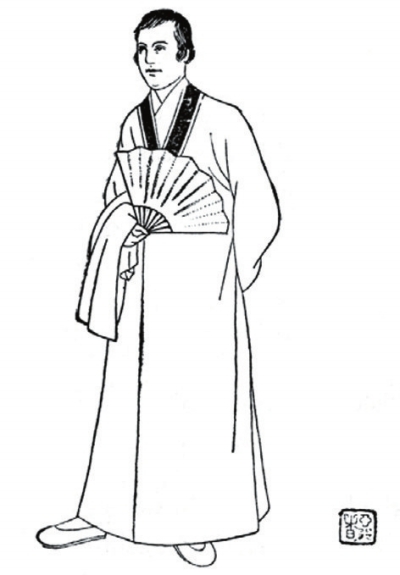
图:蒋彝笔下穿中国长袍的苏格兰诗人彭斯素描像
Image: A sketch of Scottish poet Robert Burns strolling in a traditonal Chinese robe, as depicted by Chiang Yee.
(四)魂归庐山 阔别四十载的皈依
A Return After Forty Years of Separation
无论在海外走得有多远,蒋彝的骨子里始终是一个中国文人。虽有英国皇家艺术学会会员、美国艺术科学院院士、美国哥伦比亚大学终身教授等荣誉等身,他爱国之忱、归思之意终不改。“我生为汉人,死必为汉鬼。”1972年客居香港时,他写下了无限感伤的思乡诗:“海外年年说还乡,未到乡前港已香。遥望白云依旧是,白云下有蒋家庄。”
No matter how far he traveled overseas, Chiang Yee remained a traditional Chinese scholar to his core. Though showered with glittering honors, including being elected a Fellow of the Royal Society of Arts, a Fellow of the American Academy of Arts and Sciences, and a tenured professor at Columbia University, his patriotic fervor and yearning for home never wavered. 'I was born a son of Han, and in death, I shall be a ghost of Han,' he declared. In 1972, while living temporarily in Hong Kong, he penned a deeply poignant poem filled with homesickness:'Year after year abroad, I speak of returning home,Yet before reaching my land, the fragrance of Hong Kong is known.Gazing afar, the white clouds remain just as they used to be,And beneath those very clouds lies the village of my family.'
1977年, 蒋彝重返祖国,并递交了回国定居申请。同年10月,他在北京逝世,享年74岁。遵照他的遗言,其骨灰最终安葬在故乡江西庐山脚下。漂泊半生的“哑行者”,终于叶落归根。
In 1977, Chiang Yee returned to his homeland and submitted an application for permanent residency. He passed away in Beijing that October at the age of seventy-four. In accordance with his final wishes, his ashes were laid to rest at the foot of Mount Lu in his hometown Jiujiang. The Silent Traveller, who had drifted abroad for half a lifetime, finally returned to his roots.
蒋彝的一生,是用东方之笔描绘世界的一生。他用一生的文化自信证明了:东方水墨不仅能描绘庐山的峰岭与云雾,同样能诠释苏格兰的古堡与冬雪;一颗真正爱国且包容的心、一个“各美其美,美人之美,美美与共”的大胸怀,无论走到哪里,终会赢得世界的赞许。
The life of Chiang Yee was in essence a journey of chronicling the wider world through an Eastern lens. His unwavering cultural pride stood as living proof that Chinese ink-and-wash is capable of more than just capturing the crags and vapors of Mount Lu; it can equally illuminate the ancient fortresses and winter snowfalls of Scotland. He showed that a truly patriotic yet inclusive heart, alongside a grand vision of 'cherishing one's own beauty, appreciating the beauty of others, and bringing them together in harmony,' will ultimately earn the admiration of the world, wherever one's footsteps may lead.


